In computational learning theory (machine learning and theory of computation), Rademacher complexity, named after Hans Rademacher, measures richness of a class of sets with respect to a probability distribution. The concept can also be extended to real valued functions. == Definitions == === Rademacher complexity of a set === Given a set A ⊆ R m {\displaystyle A\subseteq \mathbb {R} ^{m}} , the Rademacher complexity of A is defined as follows: Rad ( A ) := 1 m E σ [ sup a ∈ A ∑ i = 1 m σ i a i ] {\displaystyle \operatorname {Rad} (A):={\frac {1}{m}}\mathbb {E} _{\sigma }\left[\sup _{a\in A}\sum _{i=1}^{m}\sigma _{i}a_{i}\right]} where σ 1 , σ 2 , … , σ m {\displaystyle \sigma _{1},\sigma _{2},\dots ,\sigma _{m}} are independent random variables drawn from the Rademacher distribution i.e. Pr ( σ i = + 1 ) = Pr ( σ i = − 1 ) = 1 / 2 {\displaystyle \Pr(\sigma _{i}=+1)=\Pr(\sigma _{i}=-1)=1/2} for i ∈ { 1 , 2 , … , m } {\displaystyle i\in \{1,2,\dots ,m\}} , and a = ( a 1 , … , a m ) ∈ A {\displaystyle a=(a_{1},\ldots ,a_{m})\in A} . Some authors take the absolute value of the sum before taking the supremum, but if A {\displaystyle A} is symmetric this makes no difference. === Rademacher complexity of a function class === Let S = { z 1 , z 2 , … , z m } ⊆ Z {\displaystyle S=\{z_{1},z_{2},\dots ,z_{m}\}\subseteq Z} be a sample of points and consider a function class F {\displaystyle {\mathcal {F}}} of real-valued functions over Z {\displaystyle Z} . Then, the empirical Rademacher complexity of F {\displaystyle {\mathcal {F}}} given S {\displaystyle S} is defined as: Rad S ( F ) = 1 m E σ [ sup f ∈ F | ∑ i = 1 m σ i f ( z i ) | ] {\displaystyle \operatorname {Rad} _{S}({\mathcal {F}})={\frac {1}{m}}\mathbb {E} _{\sigma }\left[\sup _{f\in {\mathcal {F}}}\left|\sum _{i=1}^{m}\sigma _{i}f(z_{i})\right|\right]} This can also be written using the previous definition: Rad S ( F ) = Rad ( F ∘ S ) {\displaystyle \operatorname {Rad} _{S}({\mathcal {F}})=\operatorname {Rad} ({\mathcal {F}}\circ S)} where F ∘ S {\displaystyle {\mathcal {F}}\circ S} denotes function composition, i.e.: F ∘ S := { ( f ( z 1 ) , … , f ( z m ) ) ∣ f ∈ F } {\displaystyle {\mathcal {F}}\circ S:=\{(f(z_{1}),\ldots ,f(z_{m}))\mid f\in {\mathcal {F}}\}} The worst case empirical Rademacher complexity is Rad ¯ m ( F ) = sup S = { z 1 , … , z m } Rad S ( F ) {\displaystyle {\overline {\operatorname {Rad} }}_{m}({\mathcal {F}})=\sup _{S=\{z_{1},\dots ,z_{m}\}}\operatorname {Rad} _{S}({\mathcal {F}})} Let P {\displaystyle P} be a probability distribution over Z {\displaystyle Z} . The Rademacher complexity of the function class F {\displaystyle {\mathcal {F}}} with respect to P {\displaystyle P} for sample size m {\displaystyle m} is: Rad P , m ( F ) := E S ∼ P m [ Rad S ( F ) ] {\displaystyle \operatorname {Rad} _{P,m}({\mathcal {F}}):=\mathbb {E} _{S\sim P^{m}}\left[\operatorname {Rad} _{S}({\mathcal {F}})\right]} where the above expectation is taken over an identically independently distributed (i.i.d.) sample S = ( z 1 , z 2 , … , z m ) {\displaystyle S=(z_{1},z_{2},\dots ,z_{m})} generated according to P {\displaystyle P} . == Intuition == The Rademacher complexity is typically applied on a function class of models that are used for classification, with the goal of measuring their ability to classify points drawn from a probability space under arbitrary labellings. When the function class is rich enough, it contains functions that can appropriately adapt for each arrangement of labels, simulated by the random draw of σ i {\displaystyle \sigma _{i}} under the expectation, so that this quantity in the sum is maximized. The Rademacher complexity of a set A {\displaystyle A} can be rewritten as Rad ( A ) := 1 m E σ [ sup a ∈ A ∑ i = 1 m σ i a i ] = 1 m 2 m ∑ σ ∈ { − 1 / m , + 1 / m } m [ sup a ∈ A ⟨ σ , a ⟩ ] . {\displaystyle \operatorname {Rad} (A):={\frac {1}{m}}\mathbb {E} _{\sigma }\left[\sup _{a\in A}\sum _{i=1}^{m}\sigma _{i}a_{i}\right]={\frac {1}{{\sqrt {m}}2^{m}}}\sum _{\sigma \in \{-1/{\sqrt {m}},+1/{\sqrt {m}}\}^{m}}\left[\sup _{a\in A}\langle \sigma ,a\rangle \right].} Each term in the summation is the farthest distance of the set A {\displaystyle A} from the origin, along a unit-length direction σ {\displaystyle \sigma } . The directions are along the vertices of a hypercube. Thus, we can also write it as Rad ( A ) = 1 2 m 1 2 m − 1 ∑ σ ∈ { − 1 / m , + 1 / m } m / { − 1 , + 1 } [ sup a ∈ A ⟨ σ , a ⟩ − inf a ∈ A ⟨ σ , a ⟩ ] {\displaystyle \operatorname {Rad} (A)={\frac {1}{2{\sqrt {m}}}}{\frac {1}{2^{m-1}}}\sum _{\sigma \in \{-1/{\sqrt {m}},+1/{\sqrt {m}}\}^{m}/\{-1,+1\}}\left[\sup _{a\in A}\langle \sigma ,a\rangle -\inf _{a\in A}\langle \sigma ,a\rangle \right]} Here, the set { − 1 / m , + 1 / m } m / { − 1 , + 1 } {\displaystyle \{-1/{\sqrt {m}},+1/{\sqrt {m}}\}^{m}/\{-1,+1\}} denotes half of the vertices of a hypercube, selected so that each diagonal has exactly one vertex selected. In words, this states that 2 m Rad ( A ) {\displaystyle 2{\sqrt {m}}\operatorname {Rad} (A)} is precisely the average width of the set A {\displaystyle A} along all diagonal directions of a hypercube. == Examples == A singleton set has 0 width in any direction, so it has Rademacher complexity 0. The set A = { ( 1 , 1 ) , ( 1 , 2 ) } ⊆ R 2 {\displaystyle A=\{(1,1),(1,2)\}\subseteq \mathbb {R} ^{2}} has average width 1 / 2 {\displaystyle 1/{\sqrt {2}}} along the two diagonal directions of the square, so it has Rademacher complexity 1 / 4 {\displaystyle 1/4} . The unit cube [ 0 , 1 ] m {\displaystyle [0,1]^{m}} has constant width m {\displaystyle {\sqrt {m}}} along the diagonal directions, so it has Rademacher complexity 1 / 2 {\displaystyle 1/2} . Similarly, the unit cross-polytope { x ∈ R m : ‖ x ‖ 1 ≤ 1 } {\displaystyle \{x\in \mathbb {R} ^{m}:\|x\|_{1}\leq 1\}} has constant width 2 / m {\displaystyle 2/{\sqrt {m}}} along the diagonal directions, so it has Rademacher complexity 1 / m {\displaystyle 1/m} . == Using the Rademacher complexity == The Rademacher complexity can be used to derive data-dependent upper-bounds on the learnability of function classes. Intuitively, a function-class with smaller Rademacher complexity is easier to learn. === Bounding the representativeness === In machine learning, it is desired to have a training set that represents the true distribution of some sample data S {\displaystyle S} . This can be quantified using the notion of representativeness. Denote by P {\displaystyle P} the probability distribution from which the samples are drawn. Denote by H {\displaystyle H} the set of hypotheses (potential classifiers) and denote by F {\displaystyle {\mathcal {F}}} the corresponding set of error functions, i.e., for every hypothesis h ∈ H {\displaystyle h\in H} , there is a function f h ∈ F {\displaystyle f_{h}\in F} , that maps each training sample (features,label) to the error of the classifier h {\displaystyle h} (note in this case hypothesis and classifier are used interchangeably). For example, in the case that h {\displaystyle h} represents a binary classifier, the error function is a 0–1 loss function, i.e. the error function f h {\displaystyle f_{h}} returns 0 if h {\displaystyle h} correctly classifies a sample and 1 else. We omit the index and write f {\displaystyle f} instead of f h {\displaystyle f_{h}} when the underlying hypothesis is irrelevant. Define: L P ( f ) := E z ∼ P [ f ( z ) ] {\displaystyle L_{P}(f):=\mathbb {E} _{z\sim P}[f(z)]} – the expected error of some error function f ∈ F {\displaystyle f\in {\mathcal {F}}} on the real distribution P {\displaystyle P} ; L S ( f ) := 1 m ∑ i = 1 m f ( z i ) {\displaystyle L_{S}(f):={1 \over m}\sum _{i=1}^{m}f(z_{i})} – the estimated error of some error function f ∈ F {\displaystyle f\in {\mathcal {F}}} on the sample S {\displaystyle S} . The representativeness of the sample S {\displaystyle S} , with respect to P {\displaystyle P} and F {\displaystyle {\mathcal {F}}} , is defined as: Rep P ( F , S ) := sup f ∈ F ( L P ( f ) − L S ( f ) ) {\displaystyle \operatorname {Rep} _{P}({\mathcal {F}},S):=\sup _{f\in F}(L_{P}(f)-L_{S}(f))} Smaller representativeness is better, since it provides a way to avoid overfitting: it means that the true error of a classifier is not much higher than its estimated error, and so selecting a classifier that has low estimated error will ensure that the true error is also low. Note however that the concept of representativeness is relative and hence can not be compared across distinct samples. The expected representativeness of a sample can be bounded above by the Rademacher complexity of the function class: If F {\displaystyle {\mathcal {F}}} is a set of functions with range within [ 0 , 1 ] {\displaystyle [0,1]} , then Rad P , m ( F ) − ln 2 2 m ≤ E S ∼ P m [ Rep P ( F , S ) ] ≤ 2 Rad P , m ( F ) {\displaystyle \operatorname {Rad} _{P,m}({\mathcal {F}})-{\sqrt {\frac {\ln 2}{2m}}}\leq \mathbb {E} _{S\sim P^{m}}[\operatorname {Rep} _{P}({\
Biohybrid system
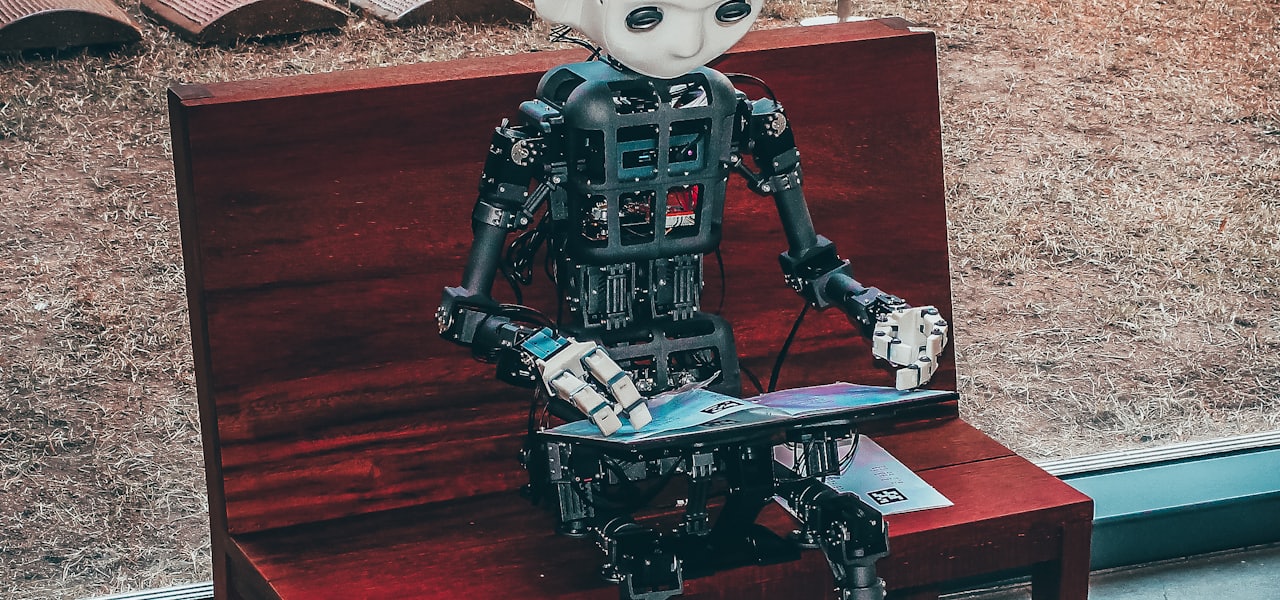
Biohybrid systems refer to the integration of biological materials, such as cells or tissues, with artificial components, including electronics or mechanical structure. This combination incorporates the capabilities of living organisms with the precision of man-made technology. As a result, these systems perform tasks that neither biology nor machines could achieve independently. Biohybrid systems might use lab-cultured muscle cells to power small robots or combine sensors with living tissue for better health sensing. The intent behind these systems is to combine the benefits of biological and technological components to introduce new solutions for complex medical challenges. Biohybrid systems may have transformative potential across sectors, such as robotics to create actuators and sensors that mimic natural muscle and nerve function, medicine in developing smart implants and drug delivery systems, in prosthetics for enhancing user control through neural or muscular interfaces and environmental sustainability for deploying biohybrid solutions for pollution sensing or remediation. == Origin == The term "biohybrid" is a compound of "bio" from biology (meaning life) and "hybrid" (referring to a combination of distinct elements), denoting a field of study. Its use helps distinguish such systems from purely biological constructs or entirely synthetic machines. Early academic mentions may include bio actuated robotics papers and foundational tissue-robot integration studies published in journals like Nature Biotechnology or Science Robotics. The emergence of the term reflects a growing recognition of the need to describe systems that do not fit cleanly into traditional categories. == Design principles == One of the most significant biohybrid challenges is to engineer interfaces between living tissue and artificial materials that are efficient. This means having precise control over adhesion at the surface, diffusion of nutrients, and signal conduction. Actuation mechanisms within the heart of these systems generate movement or mechanical response. These may be in the form of living muscle cells such as skeletal myocytes or cardiomyocytes, soft pneumatic actuators, or electrical stimulation-responsive tissues. Materials selection is equally critical. Hydrogels, elastomers like PDMS (polydimethylsiloxane), and biopolymers are commonly used due to their softness and biocompatibility. These materials must support cell viability, resist immune attack, and allow the integration of mechanical or electrical components. == Key components == At their core, biohybrid systems work by bridging living biological parts with technology. Through this integration, functionality that neither system could accomplish singularly is possible. Biological parts may be cells, tissues, or even organs—occasionally cultured in a laboratory setting. These biological parts carry out biologically inspired behaviors, such as muscle contraction or chemical sensing in the body. Technological components may constitute devices like sensors, electronic components, and mechanical structure. These manipulate the system, supply power, or transfer data. An example is a sensor that is implantable within a body and detects glucose levels as it sends information to a smart phone. By integrating these artificial and biological parts, biohybrid systems can perform advanced functions, such as tissue regeneration, real-time health monitoring, or the recovery of motor function in paralysis patients. Biohybrid systems generally consist of two major components: the biological and the mechanical. Biological components may include muscle cells for contraction, endothelial cells for vascularization, and stem cells for regenerative capabilities. Mechanical components comprise soft actuators that mimic organic motion, synthetic scaffolds that provide support and structure, and microfluidic systems that facilitate the delivery of nutrients and removal of waste. These components are combined in a manner that allows for dynamic, lifelike behavior—such as the contraction of tissue or the propagation of mechanical waves—while maintaining biocompatibility and durability. == Applications == The range of applications for biohybrid systems is broad and continuously expanding. In robotics, biohybrid structures have been used to engineer microscopic, muscle-driven machines, such as Harvard University's biohybrid stingray robot. In medical applications, they offer new alternatives for organ repair and augmentation, including biohybrid heart valves and esophageal scaffolds. Biohybrids are also promising in neural interfaces, where the goal is to create long-lasting, stable interaction between mechanical devices and brain tissue. Muscle-actuated drug response platforms are under exploration in pharmacology for modelling and real-time screening. == Examples == Several high-profile research projects have demonstrated the potential of biohybrid systems: Harvard researchers developed a biohybrid swimming ray powered by rat cardiac cells layered onto a gold skeleton, mimicking the motion of a real stingray. At the Massachusetts Institute of Technology, a cardiac pump actuated entirely by living heart muscle cells was engineered to simulate the behavior of a beating heart. Bio actuated soft robots have been built to simulate gut peristalsis, using muscle contractions to replicate natural wave-like movement in the digestive tract. == Challenges and limitations == As with many technologies that involve living systems, biohybrid systems raise important ethical and biomedical questions. Cell sourcing remains a key issue, particularly when embryonic or animal-derived cells are used. Long-term viability is another concern—living tissues must be kept alive with nutrients and oxygen, and they often degrade or elicit immune responses when implanted. Powering these biological parts presents logistical and ethical hurdles as well. Systems must either include internal mechanisms for nutrient delivery or be supported externally, which can limit portability and independence. == Future directions == Researchers are exploring self-directed, self-regulated organ substitutes and regenerative implants that can respond to their surroundings in real-time. These systems may be integrated with artificial intelligence to make them adjust to stimuli and coordinate complex behaviors. Future potential applications are wearable biohybrid systems for rehabilitation, space medicine devices for long-duration missions, and implantable devices that integrate into human physiology.
Digital classics
Digital classics is the application of the tools of digital humanities to the field of classics, or more broadly to the study of the ancient world. == History == Classics was one of the first of the humanities disciplines to adopt computing approaches; the first references to the use of computing in the classical humanities date to the early 1960s, which might be surprising considering the reputation of the discipline as old-fashioned and stuffily traditionalist. Major projects such as the Thesaurus Linguae Graecae, founded in 1972, and the text collections of the Packard Humanities Institute set the trend, and there are still a significantly large number of ancient world projects among Humanities Computing projects today. Also, the success of traditional scholarly publications in digital guises, such as seen in the Bryn Mawr Classical Review, and the early adoption of hypertext in high profile projects like the Perseus Digital Library helped to legitimize computing in the study of classics in ways that has not always been the case in other areas of the humanities. This apparent paradox may be as a result of the many methodologies and different sources of evidence that classicists have always had to embrace, from literary sources and linguistics, to art history and archaeology, history, philosophy, religious theory, ancient documents such as inscriptions and papyri, and so forth. The fragmentary nature of many of the texts and languages of the ancient world, the scattered evidence from the material culture of ancient Greece and Rome, and the necessity to evaluate all these varieties of evidence in context are particularly likely to benefit from digital approaches such as databases, text markup, image manipulation and machine learning. == Digital classics projects == There are currently several major projects that aim to encourage and develop digital approaches to classical scholarship. The Stoa Consortium at the University of Kentucky distributes news of the discipline, and serves as a peer-reviewed electronic publication venue, and encourages open source approaches to digital classics. The Perseus Project is a digital library that also provides a collection of digital texts and analysis tools to the public; principally (but not exclusively) classical. Digital Classicist is another project and community which shares information and advice about the digital humanities applied to the field of classics. Epigraphy.info is an international open community pursuing a collaborative environment for digital epigraphy. The Liverpool Classics Mailing List is a project which can be subscribed to in which one receives email regarding Classics events around the world, as well as call for papers, studentships and public lectures.
Content Credentials
Content Credentials (also known as C2PA signatures) are a digital media metadata specification. They aim to provide provenance information about a piece of media (such as an image or a video) and help prove its authenticity. They are described as the equivalent of nutrition labels for digital media. One of the stated goal of this specification is to fight online disinformation. The specification is written and maintained by the Coalition for Content Provenance and Authenticity (C2PA), a group of many media and tech organizations including Adobe, Amazon, the BBC, Google, Meta, Microsoft, OpenAI and Sony. Another organization, the Content Authenticity Initiative (CAI), is responsible for promoting the standard and accelerate its adoption. The standard relies on cryptographic digital signatures. == Adoption == There are two main stakeholders who can implement Content Credentials: Producers (softwares and hardwares that produce or modify digital media) and publishers (softwares that show digital media to users). === Producers === ==== Adobe ==== Adobe is one of the first companies to implement the specification, announcing support in Photoshop in 2021. Content Credentials can be enabled and the complete history of edits is kept. ==== Google ==== Google announced support for Content Credentials on its Pixel 10 phones in August 2025. The Content Credentials are embedded on each picture taken from the Pixel Camera, and modifications done using Google Photos. Information include picture timestamp and a non-identifiable signature that proves it was taken from a Pixel 10. As for Google Photos, a list of AI and non-AI edits are kept. Google is the first company to introduce support for Content Credentials on either phones or consumer-grade devices, and also the first company to make it available for free to all users. ==== Nikon ==== Nikon announced in 2024 that their Z6 III camera would support embedding Content Credentials in its photos. However, in 2025, a vulnerability was discovered in the software of the camera that allowed to combine unauthentic images with authentic photos and still have the resulting image with a valid digital signature. Nikon revoked the certificates. ==== Media organizations ==== CBC/Radio-Canada and the BBC both have started attaching Content Credentials to media they produce or verify. ==== OpenAI ==== OpenAI embeds Content Credentials on the images and videos it generates that includes that the media was created by AI using their platforms. ==== Sony ==== In June 2025, Sony announced the release of its Camera Verify system for press photographers and news editors using C2PA digital signatures. Initially, the system will be limited to still images, high‑end cameras, and selected news agencies. Registration with Sony Creators' Cloud is also required. === Publishers === ==== LinkedIn ==== In 2024, LinkedIn started showing a "CR" icon on images that contain Content Credentials of AI-generated images. In 2025, they announced a partnership with Adobe to allow photographers to prove ownership of images using Content Credentials. ==== TikTok ==== TikTok announced in 2024 that an "AI-generated" label would be applied to videos containing Content Credentials if they were AI-generated. In 2025, they announced that users could control the amount of AI-generated content they see, using self-reported labels, Content Credentials and an invisible, proprietary AI watermark embedded in videos by their AI editor tool. ==== YouTube ==== In 2024, YouTube started showing to users a label that reads "captured with a camera" on videos that show authentic, unedited videos taken by Content Credentials-compatible cameras.
Digital signage
Digital signage is a segment of electronic signage that uses digital display technologies to present multimedia content in both public and private environments. Content may include video, images, text, or interactive media and is typically displayed for purposes such as advertising, information dissemination, branding, or entertainment. Digital signage systems can be either networked or standalone. Networked systems are managed through centralized content management systems (CMS), often cloud-based, enabling remote updates, scheduling, real-time data integration, and dynamic content delivery. These systems may also incorporate audience analytics, IoT sensors, or AI-driven personalization. Standalone systems, by contrast, operate without a network connection. They rely on local media playback via USB drives, SD cards, or internal storage. These solutions are simpler and suitable for locations where connectivity is limited or content changes infrequently. == Applications of digital signage == Digital signage is widely used in transportation hubs, retail stores, restaurants, corporate buildings, hotels, educational institutions, healthcare facilities, and public spaces. One prominent application of digital signage is Digital Out-of-Home (DOOH) advertising, which leverages digital signage displays in public spaces to deliver targeted advertisements to people outside of their homes. DOOH has become a significant segment of digital signage, providing advertisers with a dynamic and contextually relevant way to engage with audiences. == Components == === Hardware components === Digital signage hardware includes the physical equipment used to show multimedia content in public and private spaces. ==== Display devices ==== Display devices are the most prominent components of a digital signage system, serving as the primary medium for presenting content. Display devices come in various technologies, such as LCD, LED, and OLED formats, each offering different advantages in terms of clarity, color reproduction, and energy efficiency. In addition to flat-panel displays, projectors are also commonly used in digital signage, particularly in large-scale settings. Projectors can cast large-format visuals onto walls, screens, or other surfaces, providing flexibility in display size and positioning. Screen sizes vary widely to suit different applications. Smaller panels are often used in kiosks and point-of-sale systems, while larger displays, such as video walls and projection surfaces, are deployed in venues like stadiums, auditoriums, and other public spaces. Many digital signage displays are also equipped with touchscreen capabilities, allowing for interactive applications. These interactive displays are commonly used in information kiosks, wayfinding systems, and self-service applications. ==== Playback devices ==== Playback devices are specialized hardware components that manage the storage, processing, and transmission of multimedia content to digital signage displays and projectors. They serve as the crucial link between the content management system (CMS) and the visual output, ensuring seamless playback of static images, video files, animated graphics, and real-time content, such as news feeds. Playback devices can be standalone units or integrated into display hardware using System-on-Chip (SoC) technology. The latter reduces hardware complexity and installation time, making the system more efficient. These devices support remote or local content updates, allowing digital signage operators to manage networks effectively. Content can be updated via cloud-based platforms for centralized control or through direct interfaces on-site, depending on the system's configuration and deployment requirements. ==== Mounting systems ==== Mounting systems provide structural support for digital signage displays, enabling deployment across diverse environments. Typical configurations include wall mounts, ceiling mounts, and floor stands each engineered to meet specific spatial and functional requirements. === Software components === Digital signage software is responsible for content creation, scheduling, and management. It enables users to manage and distribute content to one or more playback devices. ==== Software compatibility ==== Digital signage software supports various operating systems, including Android, Windows, Linux, iOS, tvOS, webOS, Tizen, ChromeOS, macOS, and others. This allows customers to choose the hardware and software solution that best suits their digital signage needs. == Interactivity == Interactivity in digital signage allows users to interact directly with displays using input methods like touch, gestures, voice, or proximity sensors. This feature enables real-time responses and personalized content, improving the user experience. Interactive digital signage is commonly used in places like retail, transportation, education, and public spaces to create engaging and informative interactions. Additionally, self-service kiosks are often integrated into interactive signage solutions, allowing users to perform tasks such as ordering products, checking in for flights, accessing information, or making payments. These kiosks empower users to complete transactions or obtain services independently, improving efficiency and convenience in high-traffic locations. == Audience measurement and context-aware content adaptation == === Audience measurement === Cameras can be integrated into digital signage systems to enable audience measurement. They are used to detect and count viewers, estimate demographics such as age and gender, measure dwell time and attention, and sometimes analyze emotional reactions using computer vision techniques. This process is valuable for understanding audience behavior and refining business strategies. Privacy concerns are addressed by anonymizing collected data and avoiding the storage of personally identifiable information. === Context-aware digital signage === Context-aware digital signage refers to systems that adjust content based on environmental or audience data. The infrastructure supporting context awareness, including sensors and analytics systems, also facilitates the collection of audience insights. While these insights may be primarily used for reporting, optimization, or planning future campaigns rather than immediate content adjustments, they play a crucial role in the overall context-aware ecosystem. ==== Contextual information ==== Contextual information in the realm of context-aware digital signage refers to data about the environment, audience, and other factors that influence how digital signage content is displayed. This information helps the system to deliver more relevant, timely, and personalized content to its audience. Contextual information can include, but is not limited to: Audience demographics — this can involve detecting the age, gender, or even emotional state of viewers through cameras or sensors. It helps tailor content to specific audience segments, improving engagement. Time and weather — the system may adjust content based on the time of day or current weather conditions. For example, weather-appropriate content (like a raincoat ad on a rainy day) or time-specific content (like dinner menu promotions in the evening) can be shown. Emergency information — in situations of emergency, systems can prioritize displaying urgent notifications such as fire alerts, disaster warnings, or evacuation instructions. This can be crucial for public safety in crowded environments or densely populated areas. The system may adapt content in real-time to inform and guide individuals to safety, offering location-specific instructions or emergency service contacts. == Challenges == === Display blindness === Digital signage in public spaces has been found to lose visibility, significantly diminishing its ability to capture attention. This issue, known as "Display Blindness", was identified by Müller et al. and refers to the phenomenon where digital advertisements are largely overlooked by passersby. Observations indicate that many of these advertisements fail to resonate with their audience, often being irrelevant or unengaging, which leads to passive reception and reduced interaction. == Comparison with print signage == Digital signage and traditional print signage serve similar purposes by delivering visual information to a target audience, but they differ significantly in terms of flexibility, cost, maintenance, and environmental impact. Digital signage is advantageous in low-light or nighttime environments, where its internal illumination ensures visibility without the need for external lighting, unlike printed signs, which may require additional fixtures to be seen after dark. === Content and flexibility === Digital signage allows for dynamic and real-time content updates, often controlled remotely through content management systems. This makes it well-suited for environments where information chan
Apptek
Applications Technology (AppTek) is a U.S. company headquartered in McLean, Virginia that specializes in artificial intelligence and machine learning for human language technologies. The company provides both managed and professional services for natural language processing (NLP) technologies including automatic speech recognition (ASR), neural machine translation (MT), natural-language understanding (NLU) and neural speech synthesis. AppTek's Head of Science, Prof. Dr. -Ing Hermann Ney, was awarded the IEEE James L. Flanagan Speech and Audio Processing Award in 2019 and the ISCA Medal for Scientific Achievement in 2021 for his work in natural language processing. == History == AppTek was acquired in 1998 by Lernout & Hauspie (at the time a NASDAQ publicly traded company), AppTek organized a management buy-out and went private again in 2001. In 2014, the company sold its hybrid machine translation technology to eBay and has since rebuilt the platform to modern neural-based approaches for machine translation. In 2020, SOSi acquired non-controlling interest in AppTek and became an exclusive reseller of AppTek products for U.S. federal, state, and local government entities.
Groundswell (book)
Groundswell is a book by Forrester Research executives Charlene Li and Josh Bernoff that focuses on how companies can take advantage of emerging social technologies. It was published in 2008 by Harvard Business Press. A revised edition was published in 2011. The book attempts to explain a shift in the relationship between customers and companies, in which companies are no longer able to control customers' attitudes through market research, customer service, and advertising. Instead, customers are controlling the conversation by using new media to communicate about products and companies. == Synopsis == The groundswell is characterized by several tactics that guide companies into using social technologies strategically and effectively. Listening: Businesses should listen to their customers to understand what the market is looking for in their products. In order to do this, a company needs to find out if their customers are using social technologies and how they are using them. Talking: Instead of advertising to customers, marketing departments should find creative ways to connect with users about their experience with a product and their feelings about the brand. One common method is participation in social networks. Energizing: Enthusiastic customers are part of the groundswell, and companies can recognize and appreciate these customers by creating online communities and social platforms where they can connect with the brand and provide reviews. Supporting: Businesses can harness the support of their own employees by creating internal social applications for them to connect with the brand, also known as enterprise social software. == Groundswell in action == === Examples === Some companies distinguish their product through the use of social technologies. Tom Dickson successfully marketed his Blendtec line of blenders through the viral marketing campaign Will It Blend? The groundswell spread marketing messages through Digg and YouTube with a small budget and little marketing experience. Other companies have been able to listen to and talk with the groundswell by building their own online communities. Procter & Gamble created beinggirl.com Archived 2016-04-10 at the Wayback Machine to introduce girls to P&G feminine care products. The community approach worked because the company could reach girls with information that might seem embarrassing or sensitive in a traditional marketing campaign. === Risks === Features of particular industries or companies can make direct customer engagement more difficult. For instance, some companies must work within industry regulations, national or multinational corporations must balance corporate and local engagement, and other companies must find ways to engage with customers on time-sensitive issues. == Reception == Kevin Allison of the Financial Times praised the book for its focus on Web analytics: "[Groundswell] is not so much a manifesto or a dissection of online culture as it is a how-to manual for executives and mid-level managers trying to navigate this fast-changing and often confusing environment." The book won the American Marketing Association Foundation’s Berry-AMA Book Prize for best marketing book of 2009. It was also listed by: Amazon, as one of the Top 10 Business & Investing Books of 2008 CIO Insight, as one of the Top 10 Business-Tech Books of 2008 and one of 10 Insightful Web 2.0 Books Fortune as Magazine as one of the 3 best Web books of 2008 Advertising Age as number 3 of 10 Books You Should Have Read BusinessWeek as one of the Best Innovation & Design Books of 2008 "strategy+business" as one of the Best Business Books 2008 and “Top Shelf” in Marketing